
Smart Glasses as a Travel Companion
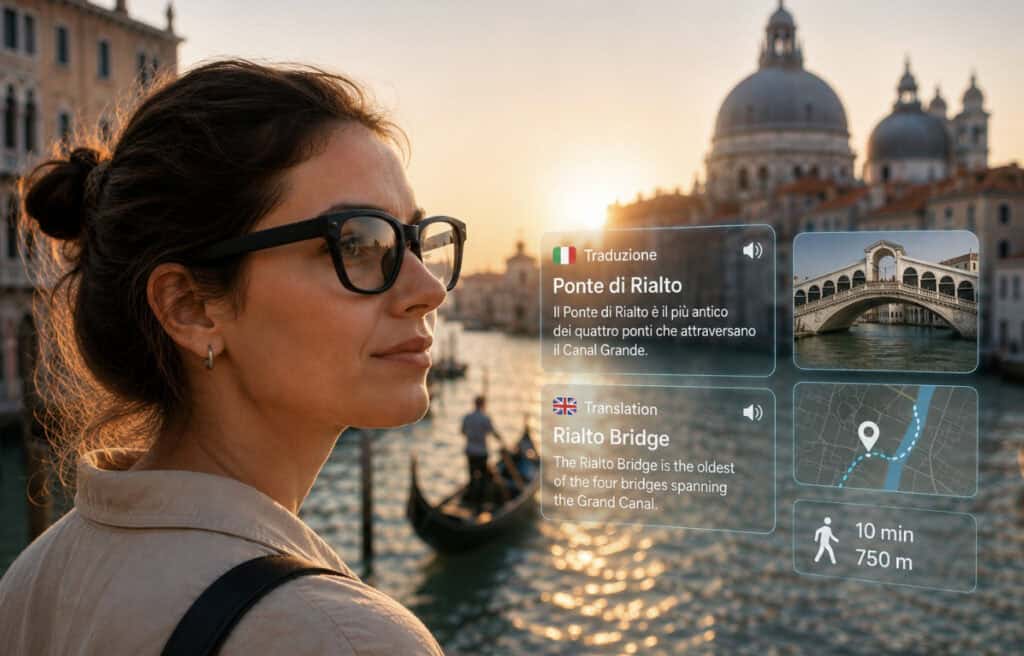
Imagine arriving in Italy, and your glasses help you during a conversation in a foreign language, guide you through the winding alleys of Venice, answer your question about who Andrea Palladio was, or tell you something about the history of St. Mark’s Square. And when something catches your interest, you can take a photo or video without having to search for your phone in your pocket. A technological novelty is gradually becoming a practical helper that we can take with us on vacation.
From tech trade shows to fashion runways
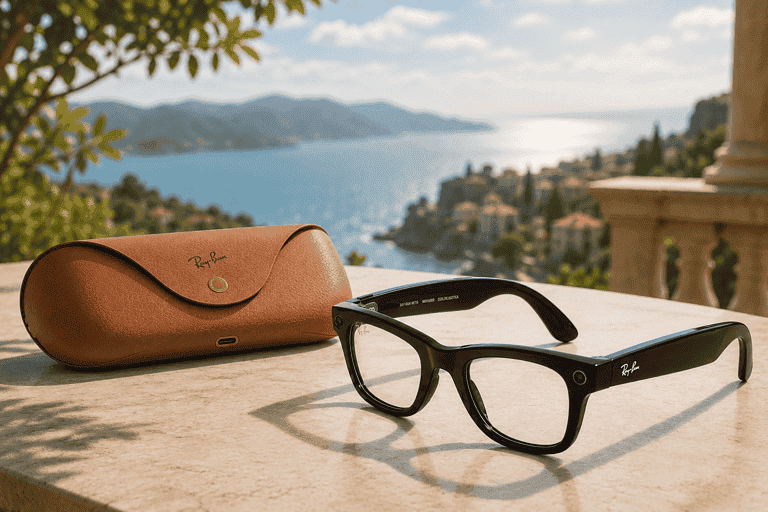
The development of smart glasses today is increasingly influenced by design and fashion. Manufacturers are trying to ensure that new models don’t look only like technological devices but instead resemble ordinary prescription glasses or sunglasses. Tech companies therefore also collaborate with eyewear manufacturers and fashion brands.
In 2025, the Rokid AR Spatial smart AR glasses system received an award for technological and aesthetic design during Milan Design Week. A year later, smart glasses drew attention during Milan Fashion Week as well. Mark Zuckerberg, whose company, Meta, is behind the Ray-Ban Meta smart glasses, sat in the front row of the Prada show as the fashion brand prepared for a possible launch of its own AI glasses.
The term “smart glasses” encompasses various types of devices. Individual models differ in their functions and in how they deliver information to the user. Some communicate primarily by voice; others can display subtitles, navigation, or other information directly in front of your eyes. You can find a more technical version of the article on Veneto Technologies. For travelers, however, what’s most interesting is, above all, what smart glasses can offer directly on the road.
Translation always at hand
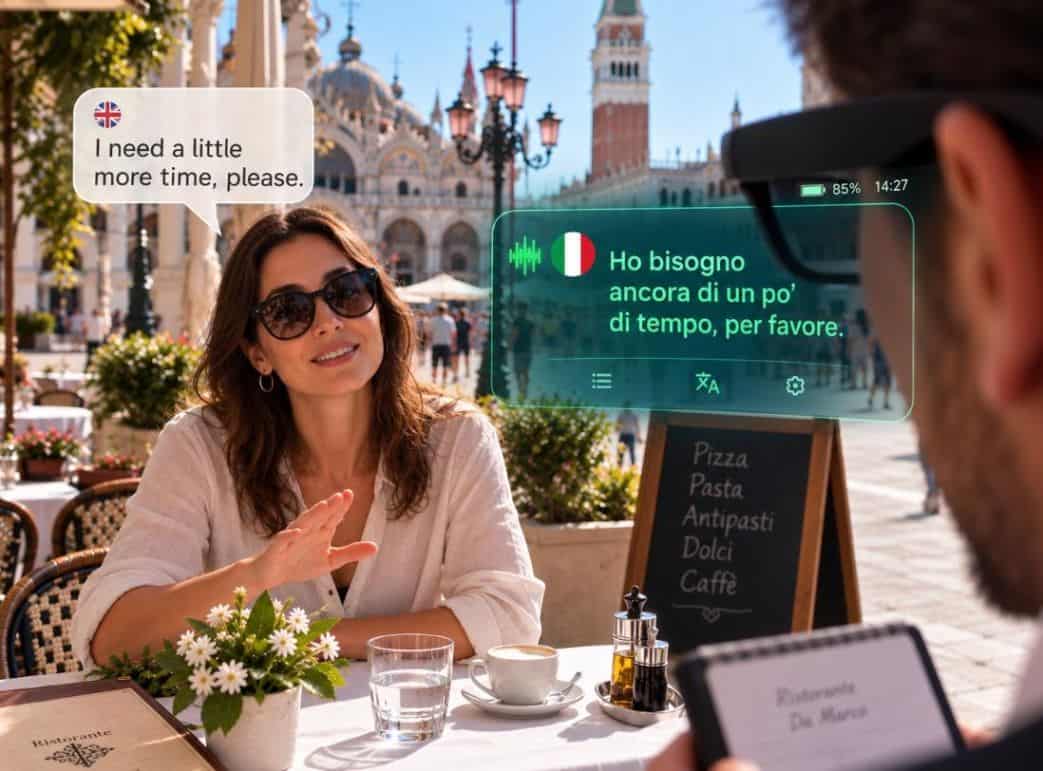
Veneto is visited by tourists from all over the world, and when traveling, we commonly encounter people who speak a different language. Even knowledge of one of the world’s languages may not always be enough. Differences in proficiency, pronunciation, or message complexity can significantly complicate communication. Translation is among the most interesting smart-glasses features for travelers. Some current models support nearly 90 languages and can translate spoken speech almost in real time.
The person in front of you speaks their language, and depending on the type of glasses, you either hear the translation or read it as subtitles in front of your eyes. With models featuring two-way translation, you can respond in your own language, and your reply will appear on the other person’s phone or be read aloud by the app.
Such help comes in handy at a hotel, restaurant, shop, or rental service. It can be even more important when you need to understand crucial information correctly, for example, during a roadside check or when visiting an emergency clinic. The translation is generated by artificial intelligence, so you should allow for potential inaccuracies. For health information, official procedures, or legally significant communication, a qualified interpreter therefore remains the right choice.

Veneto with a personal AI guide
Artificial intelligence in smart glasses can work as a personal guide you always have with you. With models equipped with a camera, it can also work with what you are currently looking at. You can ask about the building in front of you, a work of art, a local specialty, or an interesting thing you discovered along the way. The advantage is the ability to continue with follow-up questions and tailor your exploration to your own interests. An architecture lover can dive into Palladio’s work, someone else into the history of the Venetian Republic, local gastronomy, or the stories of individual landmarks. A classic guided explanation can thus become a much more personal way of discovering a place.
The information is provided by artificial intelligence, which can also make mistakes. For important factual data, it is therefore advisable to verify the information.
Venice right before your eyes
Venice is a somewhat special world for navigation. Narrow alleys, bridges, passages, and small squares can turn an apparently simple route into quite an interesting walk. With smart glasses that support navigation, directions can be delivered via audio or, on models with a display, appear directly in your line of sight. That way you don’t have to pull out your phone at every turn and check the map. The same principle can be used on other trips around the region as well. However, the specific navigation options always depend on the glasses model and the app used.

A vacation through your eyes
One of the interesting features of smart glasses is their ability to capture a moment from your perspective. You don’t have to pull out your phone, unlock it, and open the camera. With some models, it’s enough to press a button or use a voice command, and the photo or video is created directly from the viewpoint of the person wearing the glasses. It is precisely the first-person perspective that distinguishes smart glasses from ordinary phone photography. You can capture a situation as you experience it while keeping your hands free. Photos and videos can then be transferred to your phone, saved, edited, and shared.
A companion for the whole day
Today’s smart glasses are increasingly approaching classic frames in both appearance and comfort. Some models weigh around 40 to 60 grams, and many of them can also use prescription, sunglasses, or photochromic lenses. A practical question when traveling is battery life. It depends on how you use them. The camera, video, translation, or display consume more power, so with intensive use, charging may come in handy during an all-day trip. Some models use a charging case that you can take with you.
Many smart glasses work in conjunction with a mobile app and communicate with the phone, for example, via Bluetooth. AI, translation, navigation, and other online functions can also use the phone’s internet connection. When traveling, it’s therefore good to think not only about a charged battery, but also about sufficient mobile data and signal availability. In cities and seaside resorts, connectivity is usually readily available, but on trips to the Dolomites and other places with weaker signal, some functions may be limited. Selected models also offer some functions offline.

Smart glasses on the other side of the reception desk too
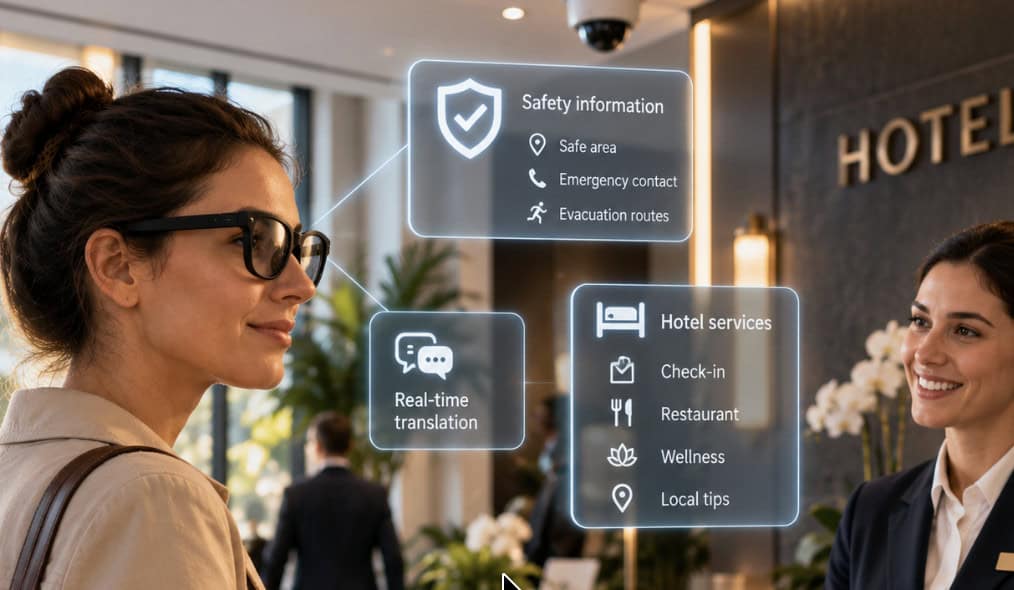
Translation can also be interesting for hotels, campsites, restaurants, information centers, or travel agencies. A hotel receptionist can use it to communicate with a guest in their language, restaurant staff will better understand a foreign visitor’s question, and an information-center employee can help with transport or orientation. In regions such as Veneto, which attracts visitors from all over the world, smart glasses can make communication easier for tourists and the people who care for them during their stay.
How much does a trip into the smart world cost
Prices for smart glasses today range from several hundred euros. More advanced models can cost 800 euros or more. The price may be increased by prescription lenses, accessories, or subscriptions to some AI and translation services. When choosing for travel, it is therefore practical to start with the functions you will actually use. For some, translation will be most important; for others, an AI assistant, navigation, photography, or a combination of several options. It’s also worth checking supported languages, phone compatibility, and battery life.
Privacy on the road
Smart glasses can work with a camera, microphone, voice, photos, or location. Some data may also be processed via online services. Before using them, it’s a good idea to review the app settings to understand how the specific device handles data, what information it stores, and which functions can be used offline. The same attention should be paid to the people around us. A camera built directly into glasses is less conspicuous than a traditional camera. When taking photos and recording video, respect for other people’s privacy and the rules of the place applies.

A helper, or just another technology we need a break from?
Smart glasses can solve a number of situations on the road for which we reach for our phone today. They translate conversations, help with orientation, provide information about the place we are currently exploring, or assist in unexpected situations. At the same time, however, they raise the question of how much technology and information we actually want to take on vacation. The constant stream of notifications, recommendations, and digital content may be exactly what we want to take a break from during our time off.
And maybe we can go even further. Do we need to know immediately, when looking at every landmark, when it was created, who built it, and exactly what we are supposed to see on it? Or is it sometimes enough to simply perceive, take a walk, observe the atmosphere, and form your own impression without additional information in front of your eyes?
Intensive use of smart glasses can also lead to eye strain or overall fatigue, especially with models that display digital content directly in front of your eyes. That’s why it makes sense to use them on the road as needed and take regular breaks. Age recommendations and restrictions may also differ among manufacturers for smart and AR glasses. Before use by children, it is therefore advisable to check the recommendations for the specific model.
Truly smart travel therefore doesn’t have to mean being constantly online and knowing absolutely everything about the place we are visiting. It can mean being able to use technology precisely when it helps us. To translate a menu, find the right vaporetto, learn something about a place that truly caught our interest, or cope in an unexpected situation. And then turn it off again. Even the option to search for nothing, read nothing, and instead just perceive can be part of traveling.